How the NHS fits together in North Cumbria

The NHS can be complicated. It's made up of lots of different organisations, services and teams, each with their own roles and responsibilities. Even people working in the system don't always have the full picture.

This guide breaks it down into its different parts, explaining who's who, what they do and how they work together from your local GP practice to the wider organisations responsible for planning and delivering health services.

First, let's get our bearings

Before looking at individual organisations, it helps to understand that NHS boundaries don't always match the boundaries we're familiar with on a map.

The key point: North Cumbria is part of a wider NHS system, but not every organisation working in that system covers exactly the same area.

"North Cumbria" refers to the west, east and north areas of Cumbria.

In 2017 Commissioning Groups confirmed they were given approval by NHS England to change the NHS’s organisational boundaries in the county with North Cumbria covering the areas of Allerdale, Copeland, Carlisle and Eden. The South Lakes in Furness area are now covered by NHS services in Morecambe Bay.

PLEASE NOTE: These NHS boundaries are not related to the county’s current council boundaries. Information about this can be found on the Westmorland and Furness Council website here. Or the Cumberland Council website here.

The diagram below illustrates in green the area represented by ‘North Cumbria’.

Map shows the split of the NHS in North Cumbria boundary... with south Cumbria as part of the Morecambe Bay NHS system/area

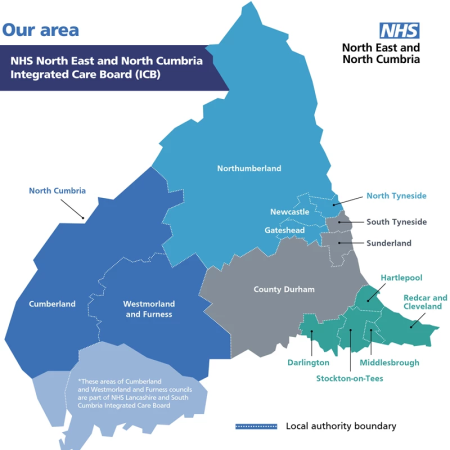
Part of the regional Integrated Care System...

We are also part of the North East and North Cumbria Integrated Care System (ICS).

This is a partnership of organisations including local councils, voluntary and community services that provide health and care across our region.

It’s led by the NHS Integrated Care Board (ICB) who are working collectively, joining up resources and expertise to provide the best health and care for our local communities.

If you look further on this NHS Guide page you'll see how this all relates to the wider system of the NHS.

You can find out more about the ICB at: northeastnorthcumbria.nhs.uk 


Map showing how North Cumbria is part of a wider area with the North East as part of the ICB / ICS area

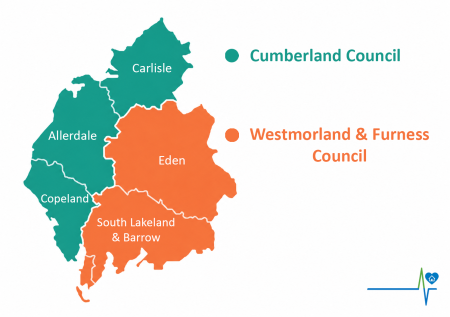
Cumbria's local government changed in April 2023, when the former county council and six district councils were replaced by two new unitary authorities: Cumberland Council and Westmorland and Furness Council.

The new boundaries were based on the areas covered by the former district councils, rather than the historic county borders. As a result, today's council areas don't follow the traditional boundaries that people may associate with Cumberland, Westmorland and Lancashire.

For example, Penrith was historically associated with Cumberland but now falls within Westmorland and Furness Council, as it was part of the former Eden district. Barrow-in-Furness and Ulverston, meanwhile, were historically in Lancashire but are now also within Westmorland and Furness.

It can seem confusing, particularly when local identity, historic county names and modern administrative boundaries don't quite line up. The key thing to remember is that Cumberland and Westmorland and Furness are today's local authority areas, not a restoration of the historic counties.

We've included this map for context, as council boundaries can help explain how some health and care services are organised across North Cumbria.

Shows the boundary split for councils between Cumberland Council and Westmorland and Furness - across the wider area of Cumbria

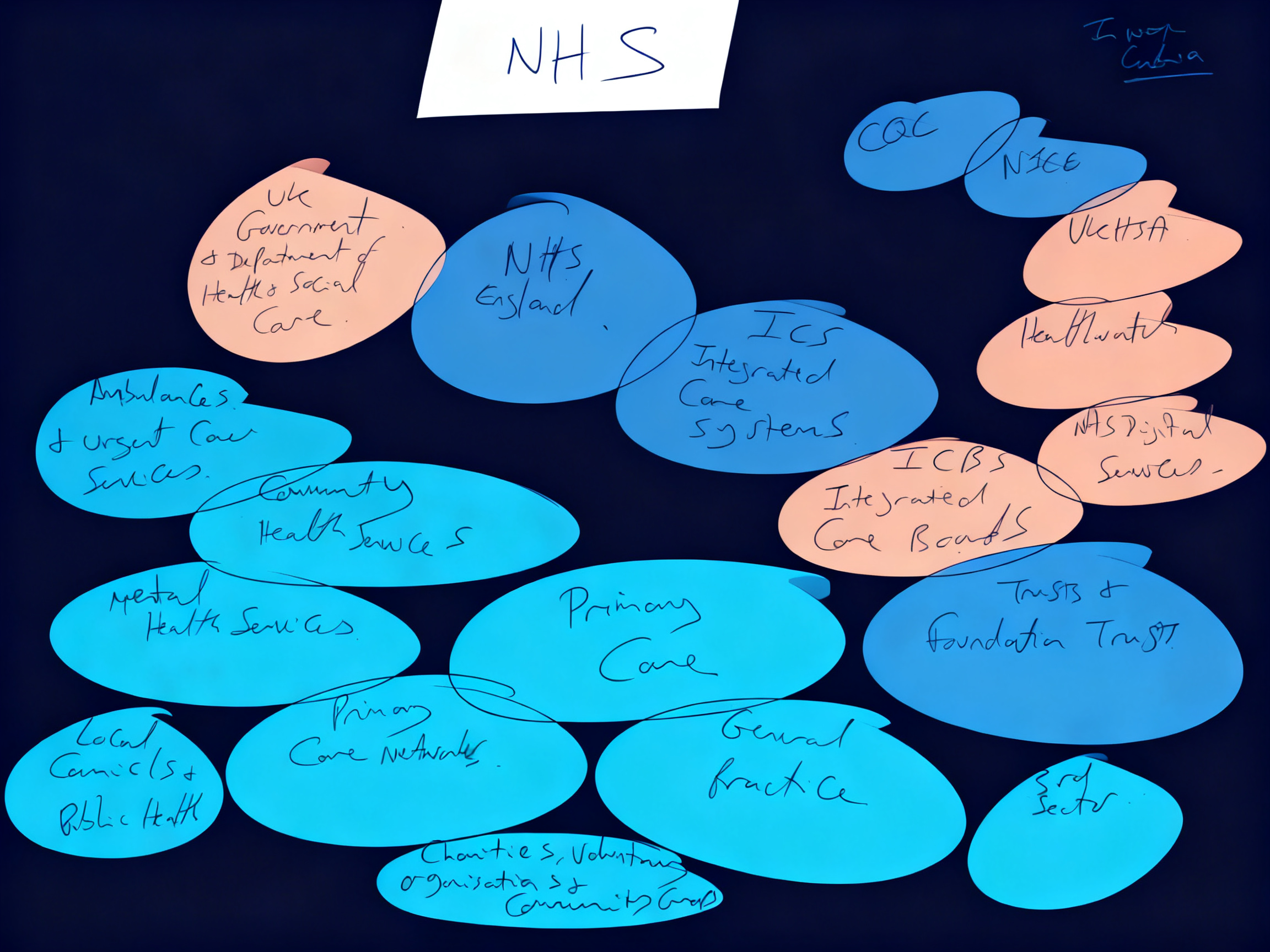
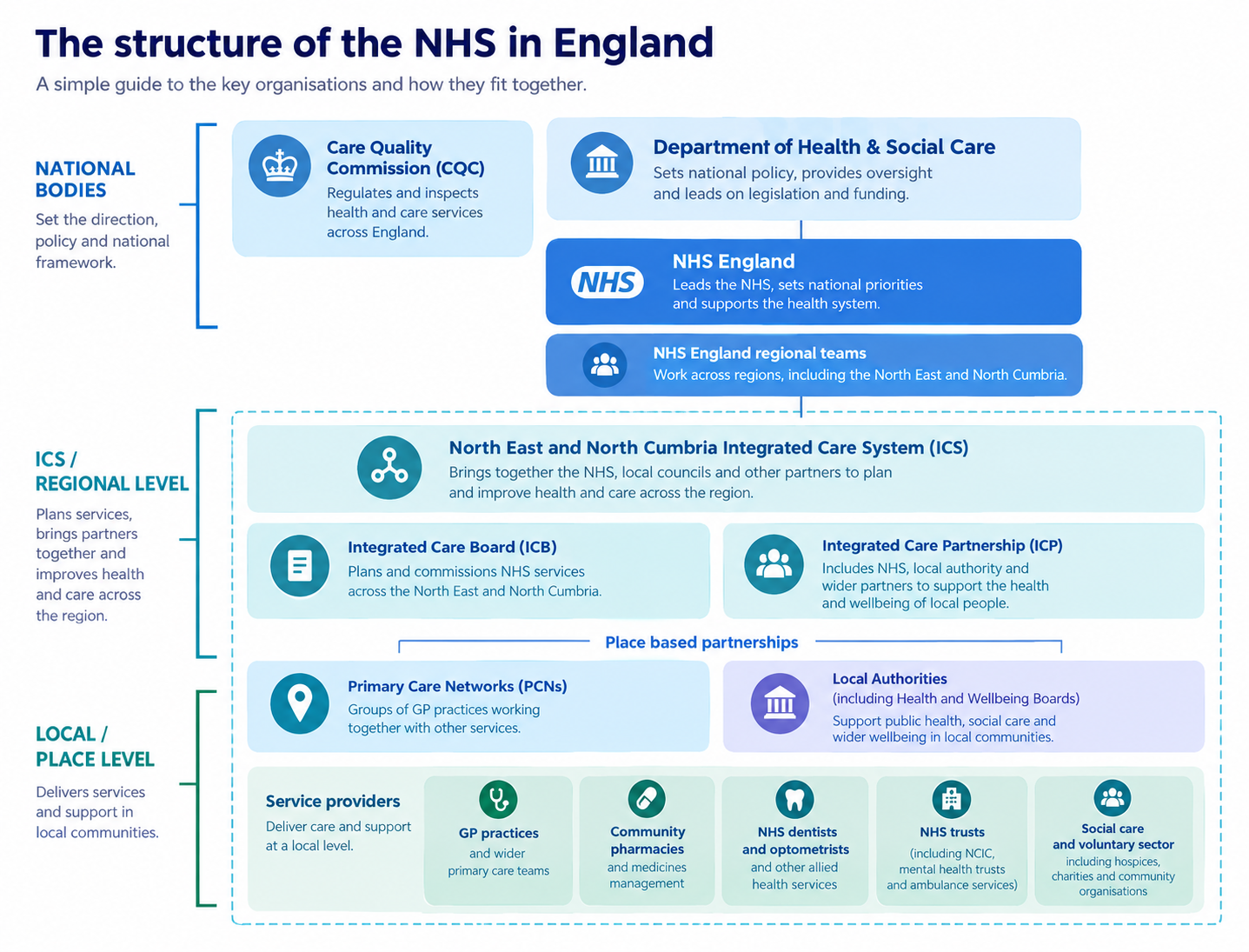
Structure Map

The NHS can be a bit of a maze. There are lots of different organisations, teams and services involved in looking after our health, and working out who's responsible for what, and how they all fit together, isn't always easy.

So, we've put together this simple overview to help join the dots, showing how the main parts of the NHS in England fit together, with a focus on the wider system that includes North Cumbria.

It's worth remembering that things aren't quite as straightforward as this chart might make them look. Different organisations have different responsibilities for planning, funding, delivering and regulating services, and they don't always fit into a neat hierarchy. On top of that, NHS structures and responsibilities are continuing to change, so some details may evolve over time.

Select image to enlarge and save file.

We've broken the overview info from the image into text in case you are using a screen reader or prefer the information as below.

The structure of the NHS in England

A simple guide to the key organisations and how they fit together.

1. National bodies

Department of Health and Social Care (DHSC)

  • Sets national policy.

  • Leads on legislation and funding.

NHS England

  • Leads the NHS and supports the health system.

  • NHS England's functions and structure are subject to change.

Care Quality Commission (CQC)

- Regulates and inspects health and care services across England.

NHS England regional teams

- Work across regions, including the North East and North Cumbria.

2. Integrated Care System (ICS) - regional level

North East and North Cumbria Integrated Care System (ICS)

Brings together the NHS, local councils and other partners to plan and improve health and care across the region.

Integrated Care Board (ICB)

- Plans and commissions NHS services across North East and North Cumbria.

Integrated Care Partnership (ICP)

- Brings together the NHS, local authorities and wider partners to support the health and wellbeing of local people.

3. Local and place-based partnerships

Primary Care Networks (PCNs)

- Groups of GP practices working together with other services.

Local authorities

  • Support public health, social care and wider wellbeing in local communities.

  • Include Cumberland Council and Westmorland and Furness Council in North Cumbria.

Health and Wellbeing Boards

- Bring together local government, health partners and communities to support local health and wellbeing priorities.

4. Local service providers

These organisations deliver care and support to people in local communities.

  • GP practices - provide general practice services and wider primary care.

  • Community pharmacies - provide medicines, advice and pharmacy services.

  • NHS dentists and optometrists - provide dental and eye care services.

  • NHS trusts and foundation trusts - provide hospital, community and other NHS services.

  • Mental health providers - provide mental health and specialist services.

  • Ambulance services - provide emergency response and urgent care.

  • Social care providers - provide support with daily living and care needs.

  • Voluntary and community organisations - including charities, hospices and community support services.

Breaking it down...

Now we've had a look at the bigger picture, let's take a closer look at the different parts that make up the NHS and wider health and care system in North Cumbria.

From the organisations responsible for planning services to the teams providing care in our communities, each has its own role to play. We'll look at who's who, what they do and how they work together, with links to further information if you'd like to explore things in more detail.

You don't need to tackle it all at once. Pick a section below to get started, or dip in and out whenever you need to make sense of a particular part of the system.

NHS Acronym Buster

A

A&E - Accident and Emergency
A hospital department providing emergency assessment and treatment for serious injuries and illnesses.

ACP - Advanced Clinical Practitioner
A healthcare professional who has developed advanced skills and knowledge to assess, diagnose and manage a range of health conditions. ACPs can come from different professional backgrounds.

ADHD - Attention Deficit Hyperactivity Disorder
A neurodevelopmental condition that can affect attention, activity levels and impulse control.

AHP - Allied Health Professional
A group of healthcare professions that includes physiotherapists, occupational therapists, radiographers, dietitians and speech and language therapists.

ANP - Advanced Nurse Practitioner
A registered nurse with advanced clinical training who can assess patients, make clinical decisions and manage a range of health conditions.

ARRS - Additional Roles Reimbursement Scheme
An NHS scheme that helps Primary Care Networks employ additional healthcare professionals and other staff to support general practice.

B

BCF - Better Care Fund
A national funding arrangement intended to support joint working between the NHS and local government, particularly around health and social care.

BMI - Body Mass Index
A measure calculated using a person's height and weight. It can help assess weight in relation to height, although it does not provide a complete picture of someone's health.

C

CCG - Clinical Commissioning Group
A former NHS organisation responsible for planning and commissioning many local health services. CCGs were replaced by Integrated Care Boards in July 2022.

CHC - NHS Continuing Healthcare
A package of care arranged and funded by the NHS for people who meet specific eligibility criteria because of their assessed health needs.

CHoC - Cumbria Health on Call
The former name associated with the organisation now known as 'Cumbria Health' (CH), which provides primary care services, including urgent and out-of-hours care.

CNTW - Cumbria, Northumberland, Tyne and Wear NHS Foundation Trust
An NHS trust providing mental health, learning disability, neurodevelopmental and other specialist services across parts of the North East and Cumbria.

CPD - Continuing Professional Development
Learning and development undertaken by healthcare professionals to maintain and improve their knowledge and skills.

CQC - Care Quality Commission
The independent regulator of health and adult social care services in England. It assesses services against standards of quality and safety.

CQC registration
The registration required for providers carrying out certain regulated health and social care activities in England.

CVS - Council for Voluntary Service
An organisation that supports charities, voluntary groups and community organisations. In Cumbria, Cumbria CVS supports the local voluntary and community sector.

D

DBS - Disclosure and Barring Service
The organisation responsible for criminal record checks and barring decisions for certain roles, including work with children and vulnerable adults.

DHSC - Department of Health and Social Care
The government department responsible for health and adult social care policy in England.

DNA - Did Not Attend
A term used when someone does not attend an appointment and has not cancelled it in advance. Services may record DNAs to understand appointment attendance and access.

DNACPR - Do Not Attempt Cardiopulmonary Resuscitation
A clinical decision and record concerning whether CPR should be attempted if a person's heart or breathing stops. It relates specifically to CPR, not to all treatment or care.

E

EPR - Electronic Patient Record
A digital record containing information about a person's care within a particular healthcare service or organisation.

ESR - Electronic Staff Record
An NHS workforce and payroll system used by many NHS organisations.

F

FCP - First Contact Practitioner
A healthcare professional, often working in primary care, who can assess patients with particular problems at their first point of contact. For example, a physiotherapist may work as a First Contact Practitioner for musculoskeletal conditions.

G

GDC - General Dental Council
The regulator of dental professionals in the UK.

GMC - General Medical Council
The regulator of doctors in the UK.

GP - General Practitioner
A doctor who provides general medical care, often working in a GP practice. GP is also commonly used when referring to general practice more broadly.

GPhC - General Pharmaceutical Council
The regulator of pharmacists, pharmacy technicians and registered pharmacy premises in Great Britain.

GPN - General Practice Nurse
A registered nurse working in a GP practice, providing care such as vaccinations, health checks, long-term condition reviews and other clinical services.

H

HCA - Healthcare Assistant
A member of the healthcare team who supports patients and clinical staff with a range of care-related tasks.

HCPC - Health and Care Professions Council
The regulator for a number of health and care professions, including physiotherapists, occupational therapists and paramedics.

HDFT - Harrogate and District NHS Foundation Trust
An NHS trust providing services including the Growing Healthy 0–19 children's health service across Cumberland and Westmorland and Furness.

HWB - Health and Wellbeing Board
A statutory partnership within local government that brings together councils, health partners and other representatives to improve local health and wellbeing and reduce health inequalities.

I

ICB - Integrated Care Board
The statutory NHS organisation responsible for planning and arranging many NHS services for its area and managing its NHS resources.

ICP - Integrated Care Partnership
A statutory partnership that brings together the Integrated Care Board, local authorities and other partners to develop a strategy for improving health, care and wellbeing across an area.

ICS - Integrated Care System
The wider partnership of NHS organisations, councils and other partners working together to improve health and care across a geographical area.

ICB, ICP and ICS - what's the difference?
The ICS is the wider system of organisations working together. The ICB has specific statutory NHS planning and resource responsibilities. The ICP brings the NHS, local authorities and other partners together to develop a wider health and care strategy.

IPC - Infection Prevention and Control
Measures and practices used to prevent infections spreading in healthcare and other settings.

L

LMC - Local Medical Committee
An organisation representing and supporting local GPs and GP practices, including on professional and contractual matters.

LSCFT - Lancashire and South Cumbria NHS Foundation Trust
An NHS trust providing mental health, learning disability and other services, primarily across Lancashire and South Cumbria.

M

MDT - Multidisciplinary Team
A group of professionals from different clinical or professional backgrounds who work together to assess needs, plan care and support patients.

MHRA - Medicines and Healthcare products Regulatory Agency
The UK regulator responsible for ensuring that medicines and medical devices meet applicable standards of safety, quality and effectiveness.

MSK - Musculoskeletal
Relating to muscles, bones, joints and other structures involved in movement. MSK services commonly support people with problems such as back pain, joint pain and injuries.

N

NCIC - North Cumbria Integrated Care NHS Foundation Trust
An NHS trust providing hospital and community healthcare services across North Cumbria.

NCPC Alliance - North Cumbria Primary Care Alliance. A collaboration of six GP practices across North Cumbria, working together to support primary care services and the communities they serve.

NENC - North East and North Cumbria
The geographical area covered by the North East and North Cumbria Integrated Care System.

NHS - National Health Service
The publicly funded health service in the UK. NHS structures and responsibilities differ across England, Scotland, Wales and Northern Ireland.

NHS 111
The NHS urgent medical help service for people who need advice or direction to appropriate care but are not dealing with a life-threatening emergency.

NHSBSA - NHS Business Services Authority
An NHS organisation providing a range of business support services, including prescription payment and dental payment administration, and other national NHS services.

NHS England (NHSE)
The national organisation historically responsible for leading the NHS in England and overseeing important aspects of NHS planning and delivery. Its functions and structures are changing, so its current responsibilities should be checked against the latest official information.

NICE - National Institute for Health and Care Excellence
The organisation that produces evidence-based guidance and recommendations on health, social care and the use of medicines and treatments in England.

NMC - Nursing and Midwifery Council
The regulator for nurses and midwives in the UK, as well as nursing associates in England.

NWAS - North West Ambulance Service NHS Trust
The NHS ambulance service covering North Cumbria and the wider North West of England.

O

OH - Occupational Health
Services that support health and wellbeing in the workplace, including advice on fitness for work, workplace adjustments and occupational health risks.

OT - Occupational Therapist
A healthcare professional who helps people manage everyday activities and maintain or improve their independence.

P

PCN - Primary Care Network
A group of neighbouring GP practices working together with other health and care services to support their local population.

PCCNC - Primary Care Collaborative North Cumbria
The collaborative bringing GP practices together across North Cumbria to support and strengthen general practice.

PCPEP - Primary Care Pharmacy Education Pathway
A training pathway designed to support pharmacists developing their clinical skills and knowledge for roles in primary care.

PCT - Primary Care Trust
A former NHS organisation that was responsible for commissioning and providing some local health services before the NHS structure changed in 2013.

PHE - Public Health England
A former national public health organisation. Its functions were transferred to other organisations in 2021, including the UK Health Security Agency and the Office for Health Improvement and Disparities.

PPG - Patient Participation Group
A group of patients who work with their GP practice to share feedback, discuss services and help improve patient experience.

R

RAG - Red, Amber, Green
A colour-coded system used to indicate status, risk or priority. The exact meaning depends on the context.

S

SALT - Speech and Language Therapy
A service supporting people with communication difficulties and eating, drinking or swallowing problems. The term is also used informally to refer to speech and language therapists.

SDEC - Same Day Emergency Care
A hospital service allowing suitable patients to be assessed, diagnosed and treated on the same day without necessarily being admitted overnight.

SNOMED CT - Systematized Nomenclature of Medicine Clinical Terms
A standardised clinical terminology used in electronic health records to record health information consistently.

T

TSI - Third Sector Infrastructure
Support organisations and networks that help voluntary, community and social enterprise organisations develop and work effectively. The exact terminology and structure vary between areas.

U

UKHSA - UK Health Security Agency
The national organisation responsible for protecting public health from infectious diseases and other health threats, including emergency preparedness.

UTC - Urgent Treatment Centre
A service providing assessment and treatment for urgent, non-life-threatening health problems that need attention but may not require an emergency department.

V

VCSE - Voluntary, Community and Social Enterprise
A term describing charities, voluntary organisations, community groups and social enterprises that contribute to local communities and services.

VCSE sector
The wider network of voluntary, community and social enterprise organisations. These organisations can provide practical help, community support, advocacy, volunteering and services that complement NHS and council provision.

W

WHO - World Health Organisation
The United Nations agency responsible for international public health.

Not all NHS jargon comes in the form of initials. These are some of the terms that can be confusing when trying to understand how health and care services work.

Commissioning

The process of assessing needs, planning services and arranging or funding services to meet those needs. Commissioning and providing care are different responsibilities.

Provider

An organisation or professional that actually delivers a health or care service. Providers may include NHS trusts, GP practices, pharmacies, councils, charities and independent organisations.

Primary care

The first point of contact for many everyday health concerns. It includes general practice, community pharmacy, NHS dentistry and optometry, alongside other services.

Secondary care

Specialist healthcare that often follows an assessment or referral from another service. Hospital outpatient appointments and many hospital-based specialist services are examples.

Community care

Health and care services provided outside a hospital setting, often in people's homes, local clinics or community facilities.

Integrated care

Different organisations and professionals working together to coordinate services and improve people's health and care.

Triage

An initial assessment used to understand someone's needs and determine the appropriate priority and next step. In general practice, this may involve gathering information before a clinician assesses the request.

Referral

A request for another healthcare professional or service to assess or treat someone.

Self-referral

When someone contacts a service directly without needing a referral from their GP or another healthcare professional, where the service permits this.

Care pathway

The sequence of assessments, treatments and support someone may receive for a particular condition or health need.

Multidisciplinary care

Care planned or delivered by professionals from different disciplines who work together to meet someone's needs.

Health inequalities

Differences in health, access to services and health outcomes between different groups of people or communities. These differences can be influenced by factors such as income, housing, education and access to support.

Public health

Work to protect and improve the health of populations, prevent illness and reduce health inequalities.

Social care

Support that helps people manage everyday life, maintain independence and meet their care needs. It may include support at home, help for carers and residential care.

Safeguarding

Actions taken to protect children and adults who may be at risk of abuse, neglect or harm.

Out-of-hours care

Health services available outside the usual opening hours of a particular service. The arrangements depend on the type of care and the area.

Elective care

Planned healthcare that is not provided as an immediate emergency. It can include planned operations, investigations and specialist appointments.

Urgent care

Assessment and treatment for health problems that need prompt attention but are not necessarily life-threatening emergencies.

Continuing healthcare

A package of care arranged and funded by the NHS for people who meet the relevant eligibility criteria because of their assessed health needs. This is distinct from social care arranged by a local authority.

Some abbreviations refer to organisations working specifically in Cumbria or across the wider North East and North Cumbria region.

Cumbria CVS: Cumbria Council for Voluntary Service, supporting voluntary, community and not-for-profit organisations across Cumbria.

Cumbria Health: The organisation formerly associated with the name CHoC, providing primary care services including urgent and out-of-hours care.

NCIC: North Cumbria Integrated Care NHS Foundation Trust, providing hospital and community healthcare.

CNTW: Cumbria, Northumberland, Tyne and Wear NHS Foundation Trust, providing mental health and other specialist services.

NCPC Alliance: North Cumbria Primary Care Alliance. A collaboration of six GP practices across North Cumbria, working together to support primary care services and the communities they serve.

NWAS: North West Ambulance Service NHS Trust, providing ambulance services across North Cumbria and the wider North West.

NENC: North East and North Cumbria, the wider regional health and care system.

PCCNC: Primary Care Collaborative North Cumbria, bringing GP practices together to support and strengthen general practice. Also known as the Collaborative. (The original project this came out of was titled Primary Care Services North Cumbria).

PCNs: Primary Care Networks, groups of GP practices working together with other local services.

LMC: Local Medical Committee, representing and supporting local GPs and GP practices.

PPGs: Patient Participation Groups, which provide a way for patients to work with their GP practice and share feedback.

Healthwatch Cumberland and Healthwatch Westmorland and Furness: Local organisations that champion people's experiences of health and social care and help ensure their views are heard.

This is not a complete list of every organisation involved in health and care across Cumbria.

You can explore more of the local organisations and partnerships in the other sections of this guide.