The NHS is a big part of the picture when it comes to health, but it isn't the whole picture.
Local councils have important responsibilities for public health, adult social care and children's services. They also work with NHS organisations and community groups on issues such as preventing illness, improving wellbeing and supporting people to live independently.
These services often work alongside the NHS, but they aren't all run or funded in the same way. Understanding who is responsible for what can help make sense of how support is organised across North Cumbria.
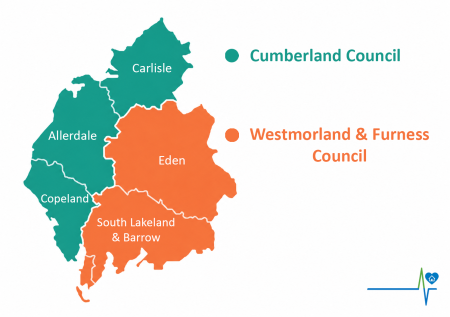
Since April 2023, local government in Cumbria has been organised around two unitary authorities: Cumberland Council and Westmorland and Furness Council.
These councils are responsible for a wide range of local services, including public health, adult social care, children's services and housing-related support.
The boundaries follow the former district council areas rather than the historic county boundaries. This means places people traditionally associate with one part of Cumbria may now fall within a different council area.
Health services don't necessarily follow the same boundaries, either. NHS organisations may cover a wider area or work across both councils, depending on the service.
We've included this overview to help explain how council responsibilities relate to health and care across North Cumbria, and why the boundaries used by different organisations don't always match.
Public Health: Helping People Stay Well
Public health is about preventing illness, improving health and helping people live healthier lives. Rather than focusing only on treating someone when they're unwell, it looks at what can be done to improve health across whole communities.
Both councils have public health responsibilities and work with NHS organisations and other partners to provide or arrange a range of services.
These can include:
Health checks to help identify the risk of conditions such as heart disease, diabetes and stroke.
Sexual health services, including testing, advice and contraception.
Stop-smoking support to help people quit.
Drug and alcohol support for people who need help with substance use.
Health improvement initiatives, including work to encourage physical activity, healthier lifestyles and better health outcomes.
Tackling health inequalities, helping address differences in health and access to support between communities.
The services available and how they're delivered can vary between council areas. Some are provided directly by councils, while others are commissioned from NHS organisations, community pharmacies or specialist providers.
Children's Health, Health Visiting and School Nursing
Supporting children to grow up healthy involves several organisations working together, from pregnancy and the early years through to adolescence.
The councils have responsibilities for public health services for children and young people, including the 0–19 Healthy Child Programme. This provides support and advice to families, helping children develop and thrive.
Depending on a child's age and needs, support may include:
Health visiting and advice for parents and carers.
Developmental reviews and identifying additional support needs.
Advice on infant feeding, healthy eating and oral health.
Support with emotional wellbeing and healthy lifestyles.
School nursing and health advice for school-age children and young people.
Councils have public health responsibilities for children and young people, including commissioning elements of the Healthy Child Programme. Services are delivered by organisations working across health and local government.. For example, Harrogate and District NHS Foundation Trust provides the Growing Healthy 0–19 service across both Cumberland and Westmorland and Furness.
Vaccinations are another example of services working together to protect public health.
School-age immunisations in North Cumbria are delivered through the NHS school-age immunisation service, provided by North Cumbria Integrated Care NHS Foundation Trust (NCIC). This includes vaccinations offered to eligible children and young people through the school programme.
Councils and public health teams can also work with NHS partners to promote vaccination, improve awareness and help address barriers to uptake.
Councils also have responsibilities for children's social care, family support and safeguarding, helping protect children and young people and support families who need additional help.
This work can involve early help services, support for children with additional needs, family hubs and safeguarding arrangements.
Schools, health visitors, school nurses, GPs, hospitals, mental health services and voluntary organisations may all play a part, depending on the circumstances.
The aim is to make sure children and families can access the right support, and that organisations work together when needs cross service boundaries.
Adult social care helps people who need support because of age, disability, illness or other circumstances.
It's generally the responsibility of local councils, rather than the NHS. Depending on a person's needs and circumstances, support may include:
Assessments to understand someone's care and support needs.
Help with daily living and remaining independent at home.
Support for unpaid carers.
Equipment and adaptations to help people manage at home.
Support with arranging care at home or in a residential setting.
Safeguarding adults who may be at risk of abuse or neglect.
The NHS and adult social care teams often work closely together, particularly when someone has complex needs or is leaving hospital and requires support to return home.
Although healthcare and social care have different responsibilities, people may need both. Good communication and joint working help ensure that support takes account of the person as a whole, rather than treating each need in isolation.
Health is affected by much more than access to medical treatment. Housing, education, employment, transport, financial circumstances and social connections can all influence how well people live.
That's why councils, NHS organisations, voluntary and community groups and other partners work together on local health and wellbeing priorities.
Some of this work takes place through formal partnerships, while other collaboration happens through individual services and local initiatives. The organisations involved may differ depending on the issue and the communities being supported.
You can find out more about the wider regional NHS and partnership arrangements in our guide to the regional NHS and Integrated Care System, and explore some of the local organisations working together across North Cumbria in our section on local partnerships and health care.